INDUSTRY TRACK- CALL FOR SPEAKER PROPOSALS
The Centre for Software and Information Technology Management (CSITM) at IIM Bangalore and the International Software Product Management Association (ISPMA) have been co-hosting the Software Product Management Summit India.
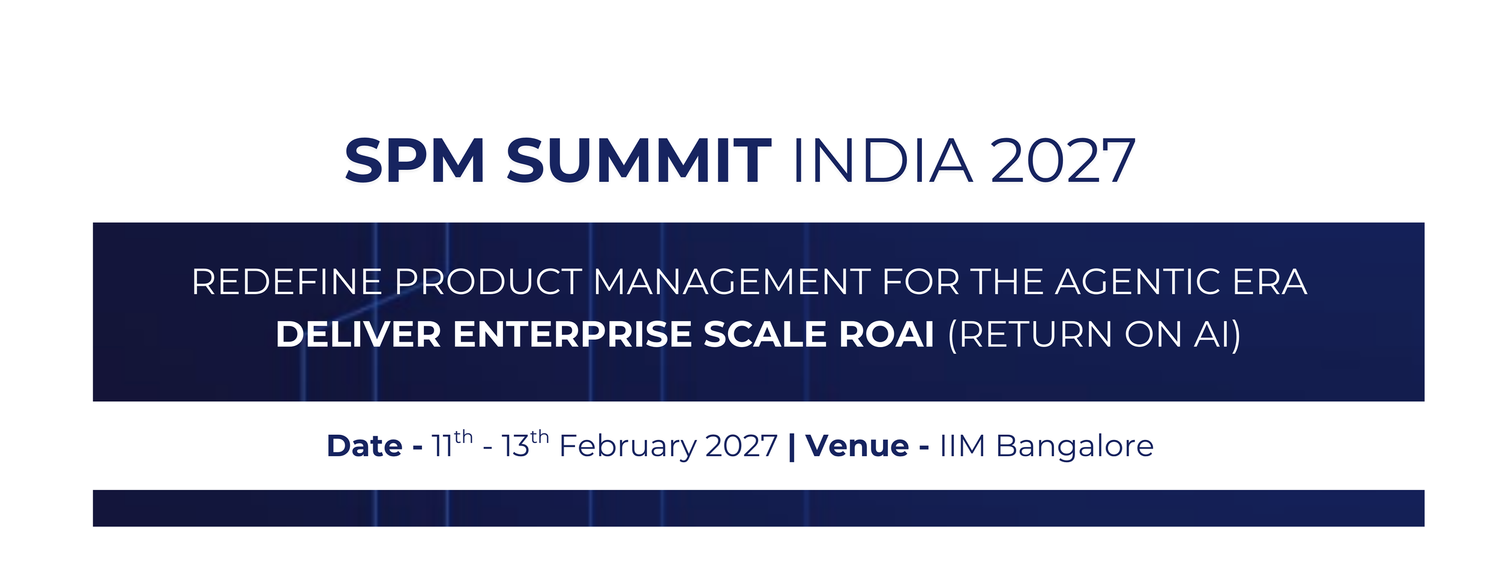
Since its inception in 2019, the Software Product Management (SPM) Summit has been a premier annual gathering of practitioners, academics, entrepreneurs, policy leaders and experts to disseminate and exchange their latest insights, experiences, and findings within the dynamic realm of Software Product Management driving the growth of the product ecosystem.
Product Management is entering a new era. Generative AI, AI agents and autonomous systems are reshaping how products are conceived, built, launched, operated and governed. When products can reason, decide and act, the PM’s role shifts from shipping features to orchestrating what work is delegated to AI, how much autonomy to grant, and how to stay accountable for outcomes. The next generation of PMs will integrate people, models, agents, data and workflows to deliver meaningful impact at enterprise scale.
Across the ecosystem, the questions are getting sharper:
Where is the real value of AI, and how do we measure Return on AI (ROAI)?
How do we make agentic products ready for real‑world use across enterprises, consumer apps and public services?
How much autonomy should AI have, and who is accountable when it acts?
How do we earn trust when products act on behalf of users?
How do founders build AI products that are defensible and scale beyond prototypes?
At its core, the summit asks every product team: What should we build, why should we build it, how much autonomy should we grant, and how do we know it creates value.
Call for Proposals
We invite proposals from practitioners, founders and industry leaders who have built, scaled or governed AI and agentic products. We’re looking for real‑world stories on choosing the right problems, setting appropriate autonomy levels, ensuring production readiness and delivering sustained value. Contributions are welcome from startups, consumer and SaaS businesses, global capability centres, large enterprises and public‑sector institutions, drawing on Indian or global markets. Sector‑specific case studies—BFSI, healthcare, public services, manufacturing, retail, agriculture, Telecommunications and education—are especially encouraged. This call is for industry contributions . Research papers are submitted through the separate research track.
Themes of Interest
We encourage proposals that challenge conventional thinking and connect Product Management with AI, business, technology, design, economics, society and organisational change.
A. Strategic Product Management and ROAI
How organisations identify valuable AI opportunities, make disciplined investment choices, and turn agentic capability into measurable outcomes for users and the business.
A1. Agentic AI and ROAI at Scale: How organisations move from compelling pilots to value at scale—selecting high‑value use cases, prioritising agentic AI portfolios, choosing AI‑native versus AI‑enabled approaches, designing multi‑agent workflows, making build/buy/partner decisions, managing dependence on model providers and sustaining advantage as models commoditise. This track also examines lessons from launches that succeeded or failed, and the business‑case discipline to know when simpler automation—or no AI—is the better choice.
A2. Data, Knowledge and Context Strong models cannot compensate for weak context. We welcome proposals on data readiness, context engineering, giving AI access to company knowledge through retrieval and knowledge graphs, enabling enterprise memory, personalisation, safely connecting agents to systems and workflows, designing products other agents can use, building on India’s digital public infrastructure, and supporting multilingual and Indic‑language context.
A3. Measuring ROAI: From Activity to Outcomes
How product teams define and measure the value AI actually creates. Topics include value‑realisation frameworks, unit economics, cost per task or outcome, pricing and monetisation shifts, protecting margins against inference costs, revenue and retention impact, AI evaluation and reliability, production observability and executive ROAI dashboards.
A4. Founder and Startup Perspectives
How AI‑native founders build, scale and monetize AI- native products with small, fast teams. Topics include product‑market fit, AI‑enabled discovery, data, model and distribution moats, consumer growth, enterprise sales, building for price‑sensitive markets, trust‑building, funding, valuation and the journey from prototype to production.
B. Product Leadership in the Multi-Agent Paradigm
How product leaders orchestrate people, agents, models, data, tools, workflows and guardrails while preserving human judgement and user value.
B1. Product Management in the Agentic Era
Agentic products push PMs beyond features and roadmaps toward delegation, autonomy and outcomes. Topics include human‑to‑agent and agent‑to‑agent workflows, AI‑assisted discovery and roadmapping (including synthetic research), AI‑native development and rapid prototyping, managing non‑deterministic behaviour, writing requirements for systems that reason and act, and shifting boundaries between product, design and engineering.
B2. Designing Trusted Human-Agent Experiences
How to design experiences where people can understand, guide and trust agent behaviour without being overwhelmed. Topics include conversational, voice‑first and multilingual agentic UX, communicating uncertainty, permissions and delegation controls, graceful failure, explainability, accessibility, inclusion, user experience, risks of persuasion and dark patterns, and designing for vulnerable users, including minors.
C. Governance, Risk, Trust, Compliance and Sustainability
How organizations create responsible autonomy, manage risk, and account for the societal and environmental consequences of AI systems that act on behalf of people and institutions.
C1. Responsible AI and Key Considerations
The governance required as agents move from recommendations to actions. Topics include autonomy boundaries, oversight and accountability, traceability, legal liability, SLAs for unpredictable behaviour, agent identity and permissions, security risks such as prompt injection and tool misuse, safety, fairness, privacy, data sovereignty, red‑teaming, regulatory readiness (including India’s DPDP Act and sector guidance) and ethical limits for autonomous systems. We also welcome work on AI’s broader societal and environmental impact—jobs and livelihoods, responsible automation in high‑consequence settings, energy and compute costs, and choosing smaller or more efficient models as a deliberate product decision.
D. The Evolving SPM Discipline: Skills, Culture and Operating Models
How product organisations build the capabilities, culture and operating models needed to adopt, scale and lead agentic AI responsibly.
D1. Adoption, Scaling and Production Readiness
Practical lessons from moving AI products into sustained production use. Topics include data and integration readiness, workflow redesign, change management, release criteria, evaluation and quality‑cost trade‑offs, operating agents after launch (stability as models change, incident handling, rollback), adoption beyond launch, unintended consequences, shifts in product/design/engineering operating models, and the evolving role of GCCs from delivery to product ownership.
D2. AI Product Management Skills for the Next Generation
The skills product professionals need as AI becomes part of daily product work—AI and context‑engineering literacy, AI economics and pricing, AI UX, data and ethics, systems thinking, career growth from APM to CPO, and leading hybrid human‑and‑agent organisations. We also welcome candid perspectives on how AI is reshaping the PM role: team sizes, entry‑level paths and which parts of product work should remain human.
Proposal Formats
Thought leadership - 30 mins ( A big idea or framework that challenges conventional thinking, The core idea and the evidence behind it)
Practitioner case study -30 mins( A real implementation, the decisions behind it and measurable outcomes, Problem, key decision, alternatives considered, evidence, lessons learned)
Workshop or masterclass -90 mins (Hands-on session that builds a specific skill or framework, What participants will create, maximum group size, prerequisites, and whether laptops or tools are needed)
Founder story -20mins (A candid account of building, scaling or failing, the pivotal decision and what you would do differently)
Lightning talk - [10 mins] One sharp idea, finding or lesson, the single point and why it matters
What We Are Looking For
We want conversations that move beyond “What can AI do?” to the harder questions of what to build, how much autonomy to give it, and how to prove it creates value. Strong proposals are practical, evidence‑based, provocative, actionable, cross‑disciplinary and honest. Vendor pitches or promotional content will not be accepted. Proposals must prioritise learning value for attendees.
Submission Guidelines
Required elements
Title and abstract (max 300 words): core thesis, relevance to theme, attendee takeaways
Format and pillar: session format + primary theme (e.g., A3, C1)
Audience level: Foundational, Intermediate, Advanced or Strategic Leadership
Three actionable takeaways
Speaker bio (max 150 words): background, credentials, speaking experience, contact details
Format‑specific requirements
Practitioner case study: problem, key decision, alternatives considered, evidence, lessons learned
Workshop/masterclass: what participants will create or be able to do; group size; prerequisites; tools/laptops needed
Additional guidelines
Confidentiality: anonymized evidence welcome (masked customer or company names)
Submission limit: Two submissions are allowed as Lead speaker2.
AI usage: AI tools may assist in drafting; ideas, evidence and experience must be your own
Not accepted: vendor pitches, product demos or promotional content
Selection Process
All submitted nominations will undergo a thorough review by our expert jury. Shortlisted candidates will receive an official invitation to speak at the SPM Summit 2027, hosted at IIM Bangalore. Selected speakers will enjoy complimentary access to the full three-day summit.
Submission Process
To submit your Proposal - Please submit the Google form
For any questions, please write to - spmsummitindia@ispma.org
Conference Chair:
Prof. S. Sadagopan, Chairman, ISPMA India Chapter, Founder-Director, IIIT Bangalore)
Venkatesh Mahadevan, Co-chair, ISPMA India, Fellow-BCS & Fellow-ISPMA
Dr. Tathagat Varma - Author of “ Theory of Cognitive Chasms: Delivering Business Value from GenAI”
Program Team:
Dr.Tathagat Varma, Industry Track Chair -Author of Theory of Cognitive Chasms: Delivering Business Value from GenAI
Anuj Pruthi, MD, Fifth Dimension Solutions
Karthik Suryanarayanan- Principal Product Consultant, Ellucian
Balaji Narasimhan, Lead Principal Product Manager, Oracle
Ramkumar Arumugam, Product Leader, Swiggy
Balaji Hariharan, Founder, Blueone.AI
Sireesha Gangavarapu- Director, Cap Gemini
Deepak Chauhan, CPO, Ezzy Ship
Priya Subbukutti, Product Manager, Atlassian
Important Dates
Submission Closes: 15th November 2026 11:59 PM IST
Submission of additional details: 30th November 2026 11:59 PM IST
Notification of Decision: 20th December 2026 11:59 PM IST
Final Deck for presentation at Summit: 15th January 2027 11:59 PM IST
Presentation at Summit: 12-13 February 2027 11:59 PM IST
For any questions, please contact us only over email at spmsummitindia@ispma.org
We look forward to your contribution and participation!
